
On May 21st, Eli Lilly released the first phase 3 results for retatrutide, and many are saying it will be the best-selling drug of all time.
All of Hollywood is on it!
The grey market is going crazy?
It’s allegedly the best GLP-1.
And yet, many are asking whether there might be too many risks: whether muscle might waste away, whether elevated heart rate could be long-term harmful, and whether tirzepatide might actually be a better choice.
I think the world we’re entering is less about GLP-1 vs no GLP-1 and more about which GLP-1.
Or more specifically, retatrutide vs tirzepatide.
Each drug has something to offer, and what you pick depends on what you are willing to trade off.
The rest of this article compares them across three variables: weight loss, muscle loss, short-term and long-term side effects.
But first, some caveats:
- This is not medical advice, nor a recommendation.
- I run Superpower, a health super app focused on bringing the best of health to all. That gives me a view into this space. We will launch peptides in the future
- I’ve personally used retatrutide and tirzepatide. My account of their effects are subjective, not clinical.
The three lenses I use
There are three forms of reasoning I always use in medicine:
- The first is research data. This means placebo-controlled trials, which many see as the truth. But trials are often not replicable. Pharma hacks trial design, and the results are often biased.
- The second is mechanism of action. This is useful for predicting things we might not have observed yet. For example, reta increases heart rate, and mechanistically a high heart rate can be harmful.
- The third is real-world evidence. Whilst the statistic monkeys dismiss it as mere anecdote, anyone trying to understand a drug pays attention to what users report in practice.
All three matter.
I’ll evaluate reta vs tirz with these three forms of reasoning against the variables of (1) weight loss, (2) muscle loss, and (3) side effects.
The mechanism in 30 seconds
A GLP-1 can be categorized by the types of receptors on the cells it binds to.
- Semaglutide (Ozempic) = single agonist. It binds to the GLP-1 receptor (for less hunger and slowed gastric emptying).
- Tirzepatide (Mounjaro, Zepbound) = double agonist. It binds to GLP-1 and GIP (for improved insulin sensitivity).
- Retatrutide = triple agonist. It binds to GLP-1, GIP, and glucagon (for increased energy production at rest).
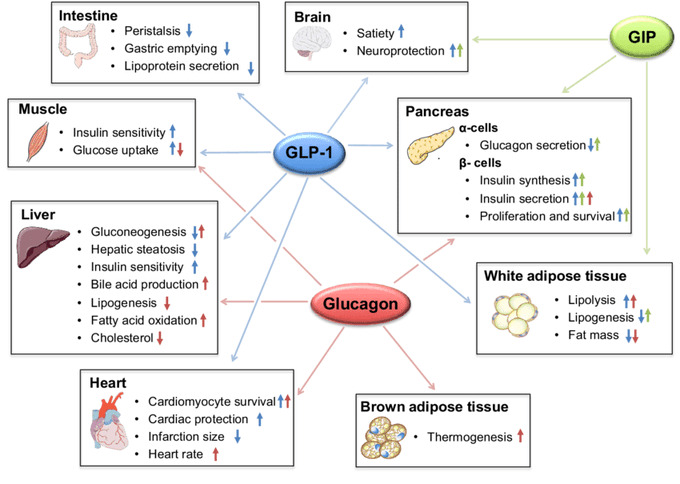
So far, what we’ve seen is that more receptors means more weight loss. Pharma even has GLP-1s targeting 5 receptors in development.
Variable 1: Weight loss
The study data
In research data (our first lens), tirzepatide’s best result so far is
22.5% weight loss at 72 weeks
on the highest dose (15 mg).
Retatrutide just did better.
The recent phase 3 trial put the highest dose (12 mg) at 28.3% weight loss in 80 weeks. Almost 1 in 2 participants lost >30% … bariatric surgery level.
So, with tirz on 22.5% and reta on 28.3%, the numbers favor retatrutide.
No one has put these drugs head-to-head yet, though a trial is running, and we might have it by December 2026.
The mechanism
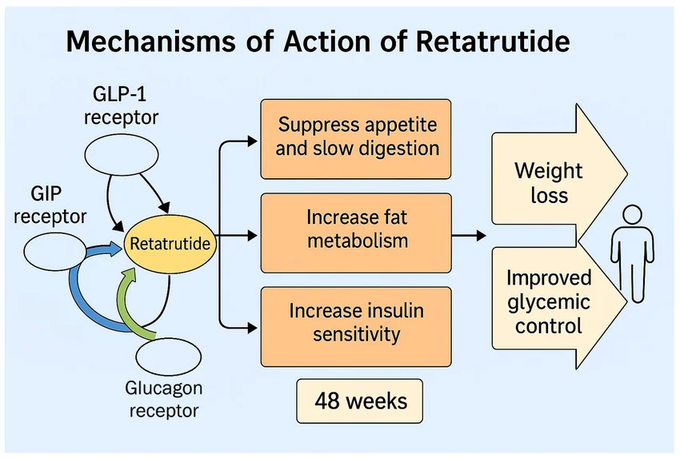
The mechanism (our second lens) is where retatrutide loses more weight because it has a third lever. GLP-1 and GIP suppress appetite, but glucagon raises energy expenditure.
So, with reta you don’t just eat less but also burn more. Mechanism supports the study data, which is what I always want to see.
The real-world evidence
The anecdotal data (our third lens) leans in retatrutide’s favor as well.
People report that they stop thinking about food on both drugs, but more dramatically on retatrutide (I can confirm this from my experience). Those who plateau on tirzepatide often report losing weight again when they switch to reta.
Variable 2: Muscle loss
The clinical data
On tirzepatide,
showed that about 25% of the weight lost was lean mass.
On retatrutide, the
showed that participants on the 8 mg and 12 mg dose lost 6.5 to 6.9 kg of lean mass over 36 weeks, which works out to roughly 37-40% of total weight lost.
In other words, retatrutide loses more total weight, but a noticeably higher proportion of that weight comes off as lean mass.
The two haven’t been compared head-to-head, so this is indirect data, but the numbers lean in tirzepatide’s favor. Is the lean mass loss on reta a function of insufficient protein intake and a sedentary lifestyle?
That’s a reasonable speculation, but it’s still speculation.
The mechanism
When it comes to the mechanism, most people in the peptide world assume the glucagon receptor helps preserve the muscle, but it does not. Glucagon is catabolic, meaning muscle-wasting. It breaks down both fat and muscle for energy.
The GLP-1 and GIP pathways appear to be more beneficial for muscle, primarily through improved insulin sensitivity and blood flow.
The mechanism slightly favors tirzepatide, but it’s debatable.
The real-world evidence
From what I can tell, the practical picture is more nuanced than the data suggests. Unfortunately, I haven’t seen any structured RWE data collection, but the anecdotes are always telling.
There are folks who claim tirzepatide will spare more muscle than retatrutide in both relative terms and absolute terms. I agree in absolute terms, because you lose less weight. But it’s still divided in terms of relative terms.
Most of the folks I see who say reta wastes muscle have only tried tirz. The bodybuilders who have tried both (and have the maximum incentive to retain muscle) seem to increasingly advocate for reta.
The data is still early, but time will tell.
Variable 3: Short-term and long-term side effects
The clinical data
The clinical data we have says both drugs cause nausea, diarrhea, vomiting, and constipation in the short term.
Retatrutide is worse for nausea
(around 40-45% of patients at the top dose in phase 3 versus
25-33% on tirzepatide
Retatrutide also has dysesthesia as a side-effect. This is a skin-tingling sensation in about 1 in 8 to 1 in 5 patients at the 12 mg dose, depending on the trial. Tirzepatide doesn’t have that.
Despite the heightened nausea, most participants stayed on retatrutide through phase 3, with low-dose discontinuation tracking placebo and high-dose only modestly above it.
But the clinical data has limits:
- It doesn’t show us very long-term possible side effects. And retatrutide might be harmful because it raises resting heart rate by 6.7 bpm at the highest dose. Mechanistic reasoning is useful here.
- It only tells us how many people stayed on the drug, not how they felt taking it. Real-world evidence is needed here.
The mechanism
Both drugs have clear mechanistic explanations in the short term.
Retatrutide activates the GIP receptor
than the body’s own GIP, and
GIP has an anti-nausea effect.
So you have the glucagon receptor adding nausea, and a super-potent GIP signal partially masking it. The third receptor (glucagon) adds the problem, and the second (GIP) hides it.
The long-term mechanism also makes sense, but it’s the part the trial data hasn’t fully caught yet.
Glucagon directly raises heart rate and contractility because that’s what glucagon does. Mechanism tells you that a 6.7bpm increase, sustained for years, is not free. Chronically elevated RHR is associated with worse cardiovascular outcomes in nearly every population it’s been
We don’t have the trial data yet to confirm or rule out the risk for reta specifically, but from the increased heart rate, I wouldn’t be surprised if we see more long-term harm from retatrutide than tirzepatide.
The real-world evidence
If we look at the real-world evidence, people on retatrutide report worse nausea than people on tirzepatide.
Bryan Johnson microdosed tirzepatide in 2025. 3 weeks in, his RHR was up 3 bpm, his HRV was down 7 points, and his sleep quality had dropped 10%, so he quit.
Another side effect that doesn’t really show up in the trial summaries is Ozempic personality. Some users feel emotionally flat on these drugs. There’s less excitement and less pull towards hedonism.
If we look at the mechanism, this makes sense because GLP-1 receptors sit on the same reward pathways that handle food, alcohol, scrolling, gambling, and sex. If you suppress the food signals, you suppress everything else.
For most people, this lands as freedom from compulsion: less drinking, less doomscrolling, less impulse spending… It’s life-changing. On the flip side, it lands as flatness.
We don’t yet know which drug does this more.
The future is a menu
Tirzepatide is proven, available, well-tolerated, and works across body types. Retatrutide is newer, bigger, less proven, and built for harder problems.
Are they really competing or are they filling adjacent slots?
I think it’s the latter.
The future of GLP-1s is a menu.
If you have 100 lbs to lose, retatrutide is likely going to be the pick. The extra weight loss is likely worth the worse split and bump in heart rate. If you have 30 lbs to lose and you lift, tirzepatide could be the better tool. It’s been around long enough, we know what it does, and the side effect profile is well-mapped.
I suspect those who are already lean and wanting longevity benefits will choose to microdose tirzepatide. But I predict that those trying to break a tirzepatide plateau will choose reta.
This menu will keep growing, and I think most people will be on something in this class within ten years.
The only question is: which one?
retatrutide vs tirzepatide.