
BPC-157 is one of the peptides that’s talked and asked about the most.
The debate sits between two extremes.
On one side, people say it’s the holy grail of healing. On the other, people say it will give you cancer. The answer lies somewhere in the middle.
Everyone on Twitter has an opinion on BPC-157, and almost all of them are shooting from the hip. This piece does the opposite. We’ll look at the actual data, apply some real reasoning, and explore both sides of the argument honestly.
By the end, you’ll understand BPC-157 better than almost anyone arguing about it online.
We can’t ignore the thousands of powerful anecdotes around it. No good scientist would. And yet we also can’t say that BPC-157 is without risks. Few things are, and we need more data.
So, let’s actually look at this and answer the most common questions.
– What is BPC-157, and how does it work? – Why is everyone talking about it? – What does it actually do? – What does the evidence look like? – Does it cause cancer, and is it safe?
Before we dive in, a few caveats first:
- This article is for informational purposes only and is not medical advice.
- BPC-157 is not approved by the FDA for human use.
- Talk to a doctor before making any decisions about your health.
Why is everyone talking about BPC-157
If you open any peptide forum, scroll through Twitter, or listen to a few episodes of any health podcast, you will probably hear about this peptide.
People are claiming that:
– It heals tendon injuries in weeks, sometimes days, instead of months – It fixes gut issues – It works on bone, ligament, muscle, and nerve – It lets athletes skip surgery – It might cause cancer The cancer concern is real enough that even people who swear by the peptide hesitate to recommend it to family members with any cancer history. We’ll get into the actual science later, but the fear is part of the conversation.
Joe Rogan has been one of the loudest voices on BPC-157 for years, crediting it for healing his elbow injury. Dr. Andrew Huberman used it for back pain. UFC fighters and other athletes use it too, and interestingly, the World Anti-Doping Agency (WADA) banned BPC-157 in 2022.
Which leaves an open question: If BPC-157 is banned by USADA does that mean that it works?
The correct answer is that we don’t know.
What is BPC-157?
BPC-157 is a synthetic 15-amino-acid peptide derived from a larger body protection compound that was reportedly isolated from gastric juice. It was first synthesized in the 1990s by an academic research group in Croatia.
This is where things get murky.
The parent protein was only ever partially sequenced.
described it as a roughly 40,000-dalton folded protein with a partial sequence from the N-terminus, and the full sequence has never been published.
In other words, the body makes the larger parent protein (BPC), but not BPC-157 itself. The 15-amino-acid version everyone injects is made in a lab.
We don’t understand its mechanism of action (MOA). What we have is animal data, a small number of human pilot studies, and a lot of anecdotes suggesting it helps. How it actually does so remains an enigma.
What BPC-157 supposedly does
In animal studies, it does several things (with surprisingly few adverse side effects reported), including tendon healing, gut repair, bone regeneration, and even reversing the gut damage that ibuprofen causes.
The animal data points in the same direction across 30 years, but as we’ll see in a moment, that data has problems, and human data is still thin.
The evidence problem
More than 80% of all published BPC-157 research comes from a single lab in Croatia with no independent confirmation. The senior author of this work holds patents and partly owns the company that sells it. The only registered clinical trial in humans has been listed as unknown status for more than a decade, which means it never finished or never started.
The proposed uses have drifted from stomach ulcers to multiple sclerosis to sports injuries without anyone outside that group confirming much.
This is not what a well-tested and safe drug looks like.
A few things have changed recently. In 2025, a major orthopaedic journal published
the first systematic review of BPC-157
from a sports medicine perspective.
More precisely, a small number of human-facing studies have now been published.
- 16 patients with chronic knee pain in 2021 with 87.5% reporting real relief 6-12 months later
- 12 women with severe bladder pain in 2024 with most reporting complete symptom relief after a single injection
- 2 healthy adults given a large IV dose in 2025, with no side effects, and BPC-157 cleared from their system within a day
These studies are small and don’t have placebo groups. On top of this, most come from clinics that sell BPC-157 treatment. Frankly, they are not enough to settle anything, but zero human evidence is no longer the right description of this peptide.
The cancer question
The prevailing objection to BPC-157 is that it might cause cancer.
The argument is that it grows new blood vessels, and tumors need new blood vessels to grow. There’s a cancer drug called Avastin that works by blocking blood vessel growth to starve tumors. So, a drug that does the opposite of Avastin, logically, must be doing the opposite of it.
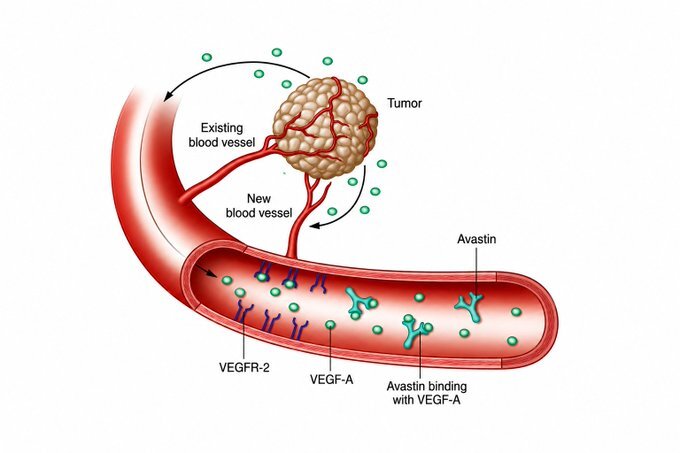
The actual cancer studies on BPC-157, of which there are a few, complicate that argument.
A 2004 study found that BPC-157 slowed the growth of human melanoma cells in a dish by blocking the molecular signal (the MAPK pathway) that VEGF (vascular endothelial growth factor) normally uses to tell cancer cells to divide. Even though BPC-157 raises VEGF in healing contexts, here it blocked VEGF’s downstream effect in cancer cells.
In mice with colon cancer, it reduced the muscle wasting that often accompanies advanced cancer and the mice lived longer.
Are there any studies pointing the other way? Not really.
No published research has shown BPC-157 causing cancer or accelerating tumor growth in animal models.
Whether that holds up under proper testing is another question.
On top of this, there is a theoretical concern that, because BPC-157 raises growth hormone receptors locally, combining it with peptides that boost overall GH production (CJC-1295, tesamorelin, ipamorelin, etc.) is probably not a good idea, especially for anyone with real cancer risk.
None of this proves that BPC-157 is safe for cancer patients or proves anything at all in humans.
The case for BPC-157
There are roughly 200 studies on PubMed (mostly preclinical) broadly pointing the same direction.
Three small human pilot studies have now been published. No serious adverse events have been reported in 30 years of widespread use, and researches haven’t been able to identity a lethal dose. Thousands of athletes and biohackers report strong-real world results, and the WADA banned it in 2022.
So despite the gaps in the evidence base, the case for BPC-157 is not nothing.
Safety, dosing, and regulation
To this day, no serious adverse events have been reported.
In animal studies, researchers haven’t been able to identify a lethal dose at all. They’ve dosed animals at hundreds of times the therapeutic amount without serious harm.
For comparison, you can kill yourself if you drink too much water.
Also, BPC-157 doesn’t really
leave the body.
Enzymes break it down into smaller peptide fragments within minutes, and those fragments eventually break down into individual amino acids that get recycled into the body’s normal amino acid pool. The intact peptide has a half-life of about 30 minutes and becomes undetectable in the bloodstream within 4 hours.
A short-half life like this may help limit risk. In the only human pharmacokinetic study, two adults given a large IV dose cleared it from their bloodstream within 24 hours.
Most people take 250 to 500 micrograms under the skin, 2 to 3 times a week, for 4 to 8 week cycle, then stop for 8 to 10 weeks before starting again. Taking it every day is probably a mistake, even if it’s hard to point a specific harm from doing so.
In September 2023, the FDA blocked compounding pharmacies from making BPC-157.
In February 2026, RFK Jr. announced on Joe Rogan (a venue chosen, I suspect, for an audience already sympathetic to the cause) that BPC-157 would be among 14 peptides moved back to Category 1, meaning, restoring legal access through compounding pharmacies.
This is a meaningful regulatory shift, but it doesn’t prove anything.
Where this leaves us
BPC-157 sits somewhere in the middle.
We have 30 years of animal research and three small human studies that point the same direction. No serious adverse effects have been reported. And we have thousands of people using it based on anecdotal data.
Are there studies that point in the opposite direction? Not really, and that’s the problem.
In 30 years of published research, nearly every paper has reported a beneficial effect. Independent reviewers have flagged this as a sign of publication bias rather than proof the peptide works. In legitimate research areas, you’d expect at least some studies showing no effect or negative effects.
The fact that the literature is this clean is statistically unusual and worth holding in mind.
We need more data, and until we have it, treat the loud voices on both sides with skepticism, including this one.