
Description
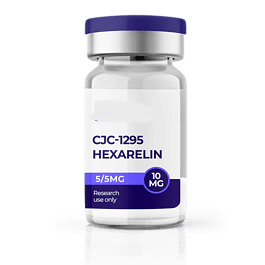
CJC-1295 (no DAC) and Hexarelin are synthetic peptides often discussed together for their strong influence on growth hormone (GH) release. When combined, they are intended to stimulate the body’s natural GH production through two complementary signaling pathways. This blend is commonly referenced in research and performance-focused discussions, but it is not an approved medical therapy.
What CJC-1295 (No DAC) Is
CJC-1295 (no DAC) is a short-acting analogue of growth hormone–releasing hormone (GHRH). Its primary function is to signal the pituitary gland to increase the amount of growth hormone released during each natural pulse. Because it does not include a drug affinity complex (DAC), it remains active for a relatively short time and is designed to align more closely with the body’s normal GH secretion rhythm.
This short duration is often viewed as a way to avoid prolonged, non-physiologic hormone elevation.
What Hexarelin Is
Hexarelin is a potent growth hormone–releasing peptide (GHRP). It works by mimicking ghrelin, a hormone that stimulates GH release through a separate receptor pathway than GHRH. Hexarelin is known for strongly increasing the frequency and intensity of GH pulses.
Compared to milder peptides, Hexarelin is often described as more aggressive in its GH-stimulating effect. Because of this potency, it has also been associated with broader hormonal effects, which has made it a subject of both interest and caution in research discussions.
How the Blend Works
The combination of CJC-1295 (no DAC) and Hexarelin is designed to produce a synergistic increase in growth hormone output. CJC-1295 enhances the size of GH pulses, while Hexarelin increases how often and how strongly those pulses occur.
By activating both the GHRH and ghrelin receptor pathways, the blend may lead to a more pronounced GH response than either compound alone. This dual-pathway stimulation is the primary reason the combination receives attention in performance and recovery-related research.
Potential Areas of Interest
The CJC-1295 and Hexarelin blend is commonly associated with research into:
-
Growth hormone and IGF-1 elevation
-
Muscle recovery and repair
-
Strength and performance-related outcomes
-
Body composition changes
-
Bone density and connective tissue support
-
Recovery from intense physical stress
These areas are based on the biological role of growth hormone and early-stage research rather than confirmed clinical applications.
Research Status and Evidence
Both CJC-1295 (no DAC) and Hexarelin have been studied individually in controlled research environments to better understand GH release mechanisms. However, data on their combined use is limited, especially in long-term human studies.
As a result, this blend remains classified as a research compound. Claims of predictable or dramatic outcomes should be approached cautiously, as they often exceed what current evidence supports.
Biochemical Characteristics
Hexarelin is commonly used in laboratory settings to probe ghrelin receptor pharmacology, including ligand-dependent signaling bias, intracellular calcium mobilization, and downstream second-messenger responses. CJC-1295 is a synthetic GHRH analog used to evaluate GHRHR-mediated cAMP signaling and regulated endocrine pulsatility. In combined paradigms, these ligands enable comparative assessment of Ca2+-dependent (GHSR-1a) and cAMP-dependent (GHRHR) pathway engagement.
Research Applications
Experimental applications for Hexarelin + CJC-1295 co-administration designs include:
- Characterization of pituitary receptor cross-talk and endocrine pulsatility under dual-receptor stimulation
- Signal transduction profiling in cell-based assays (e.g., cAMP readouts, Ca2+ flux, MAPK/ERK pathway activation)
- Preclinical evaluation of tissue-specific receptor expression and downstream molecular responses in cardiovascular and metabolic research models
Pathway / Mechanistic Context
GHSR-1a activation by hexarelin is associated with phospholipase C (PLC) activation and intracellular Ca2+ mobilization, with reported downstream effects on kinase signaling pathways and calcium-handling proteins in selected preclinical systems. GHRHR activation by CJC-1295 primarily signals via Gs-mediated adenylate cyclase activation, increasing intracellular cAMP and engaging protein kinase A (PKA)–linked transcriptional mechanisms. Dual-ligand experimental designs are used to examine how these distinct signaling modules interact to shape temporal endocrine output and tissue-specific molecular endpoints.
Reviews
There are no reviews yet.